Who Are The Best Offensive College Basketball Teams in the Country Over The Last Five Years

I’ll be honest, I’m over football season. It may be due to having my heart ripped out of my chest twice this past weekend as a Kentucky and Giants fan, but either way I’ve moved on to basketball season. Luckily enough, basketball season starts this week.
Practices officially begin on Friday with Midnight Madness happening on both October 6 and October 13 depending what school you’re looking at. So with the season here, it’s officially preview season and we’ll be looking at a bunch of different things heading into the season. There will be the traditional top-25, best players list, conference previews and all that jazz, but we’ll also go more in depth, looking at different offensive and defensive sets and what makes teams so consistently good. We looked at baseline out of bounds last week and we’ll do more of that stuff as we get ready for the season to start.
Today though, I want to focus on offense as a whole. Who are the teams out there that have been consistently good on the offensive side of the ball. For this, I took just the six major conferences and charted points per possession the last five years. There are different stats you can look at in terms of offense, whether it’s points per game, points per possession, percentages, etc, but to me PPP is the most fair way and accurate way to judge how consistent an offense is. Overall, offense has been up a little bit, with the average PPP of the last five years being .914 between the six conferences. Of the 75 teams, 36 of them are averaging more than that.
So who are the best teams? Here are the five best teams over the last five years, I don’t think it’s much of a surprise:
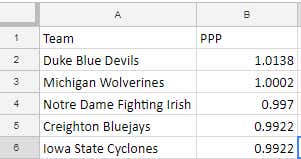
There you have it. Duke is consistently the best offensive team in the country with Michigan right behind them. Most of this is due to the importance of the 3-point line, as it is with all these teams. We’re going to dive in on what makes these guys so good offensively and look at some of their sets, but averaging over a point per possession for five years is downright impressive. On the flip side, the worst teams? Rutgers (.842), TCU (.851), Georgia Tech (.853), South Carolina (.855) and Mississippi State (.856).
Duke’s offense is based on a 4-out, 1-in with plenty of space. This is a ton of credit to K, who switched his philosophy as the game changed from a 3-out, 2-in motion to this new 4-out that we’ve seen. The motion is all spacing based, with perimeter players cutting through the middle of the lane and resetting back on the wing. Along with the cuts, there’s a dribble-drive sense in the wing looking to attack the open space in the high lane and looking for a kickout. While it is space based, this is the motion offense that uses a lot more dribbling than what we’re used to seeing, especially when you compare it to Michigan’s 2-guard motion offense.
The other thing Duke does extremely well is get into a secondary break. They do look to push the floor, but they also have designed secondary transition breaks that are quick hitters. The key to Duke’s secondary transition is the post player trailing and starting the play off with a down screen for a wing. The wing will then curl to the free throw line area, sometimes just a hair under, so he can then go opposite wing after coming off another screen. As that’s happening the opposite wing is running a curl to clear the floor and coming off another screen by the post player.
On this play you can see the development happening, but the first read to Kennard led to a wide-open shot. Once Allen makes the pass, he goes down the lane to where Jefferson is to begin to clear out opposite corner of where he came from. That leaves a ton of space for Kennard as he comes up off the pseudo-screen from Jefferson for a wide-open three.
For Michigan, it’s based all around cutting and spacing and there’s a reason John Beilein was voted the best offensive coach in the country by his peers last year. The 2-guard offense has Princeton style principals and starts in a 2-3 look. The basic motion starts with the point passing to a wing then cutting to the corner. Opposite wing will then v-cut up to receive a swing pass and take a few dribbles to opposite side. From there, the guy in the middle of the 3 set (typically your 5) will go set a screen for the wing on the ball side to pop up and look for a 3. After the screen the five rolls to the post, opposite wing moves to the elbow and the point moves back up to the wing. Now they are set with a look in the post, a reverse pass or a three.
The main premise here is to beat guys with cuts. They look for backdoor cuts or off of a flare screen for the three. Michigan’s system is designed for wings and stretch players to thrive in this as it’s constantly moving and bringing players away from the basket. They aren’t looking for guys to beat defenders off the dribble like Duke does and you rarely see an ISO set. The two-guard offense is also designed to wear defenses down as they’ll reverse the court and run cuts for 20 seconds at a time. In fact, Michigan is one of the slowest teams in the country as they averaged 19.6 seconds per possession (they are only quicker than 16 teams in the country).
The thing that makes Beilein such a good offensive coach is the sets out of the basic 2-guard offense. He has a chin set, a shuffle set, the basic motion and a pin-down play. All bring a variety of looks out of the same set but more importantly put defenders in weird positions. He recruits bigs that can shoot and will have guards slipping screens or running guard on guard handoffs instead of the traditional guard off a big. Here you can see the cutting and off ball screens by Wagner. The shot by Wilson becomes open due to the spacing and ability to slip the pick up top.
Notre Dame is another team you think of when it comes to high-power offense. That’s because Mike Brey, similar to K and Beilein, preaches spacing on the offensive side of the ball. Despite typically having a smaller team, Brey’s motion offense will be a 3-2 set with the initial move being the 4 and 5 screening for the 2 and 3. The premise of Brey’s motion offense (remember he is from the Duke coaching tree) varies in the sense that he likes to use screening pairs and uses the 3-point line as a basis. After the 4 and 5 screen for the guards, the 4 will screen for the 5. At the same time the 1 and the 3 are working together on screens. Similar to Michigan here, ball reversal is a key for Notre Dame. They’ll look to switch the floor and then immediately go screen. What I love about Brey is his attention to detail in terms of where cuts happen. He’s said the key to his most common run play is making sure a player has a foot in the lane when they make their cut.
Brey has started to develop more and more NBA looks into his motion offense. The most common one he uses now is a side pick-and-roll with an empty lane. He brings his guys up past the free throw line and into the corner, the big comes and sets the screen at free throw line extended behind the 3-point line. That makes the defense make a decision. They either have to leave a shooter to help the roll or hope they can get in position in time when the big rolls. Most often these sideline ball screens come after the wing catches the ball from a cut on the other side of the court. You’ll also see Notre Dame run a floppy set or the horns set that the NBA loves now.
Another unique thing that Brey does is run a ‘release’ set with his big. This is when Notre Dame isn’t comfortable making an entry pass along with the opponent big being uncomfortable guarding away from the post. The big will come up high in the motion set while the 1 dribbles away from him. At that time the 5 will make some sort of quick move, whether it’s a duck into the high post or a flash cut to start the offense. It’s something you don’t see a lot of as most teams still don’t have that big they trust being able to not only catch the pass that high but make a play. Another thing that is evident here with Notre Dame’s offense is the ability to read and make the correct pass. The Irish ranked 52nd last year in assists per FGM with 57.8.
Last year, Notre Dame would run more of a ‘wheel’ type motion. What I mean by that is they’d bring Colson up to the top of the key. There’d be a screen opposite of Colson for the wing up to intiate the offense. The wing on Colson’s side would then run a shallow baseline cut off of a screen of the opposite screener. Farrell, after making the pass, would then run off a Colson screen to begin the wheel. He’d end up running off another screen to opposite corner while he gets replaced by opposite wing. Colson then pops up to catch the ball at the top of the key, where Notre Dame typically had a mismatch. You can see this action here, as we’ll see a lot of it again this year with Colson being that unique player in the Notre Dame system.
So this a look at just some of the best and most consistent offenses in the country. I was somewhat surprised to see Creighton in the top-5, but that’s a good example of a star (McDermott) setting them up and then a good scheme with guys like Watson/Foster/Thomas the last couple of years. I would expect Duke, Michigan and Notre Dame to rank high again this year as the schemes by the three coaches don’t necessarily change from a fundamental standpoint year over year.